Holly Baker
emailing with Ainsley Johnston
Hi Holly, I want to start our pen-pal exchange with the visual essay New Rules by Charlotte Malterre-Barthes and Zosia Dzierżawska as one of the first pieces you worked on with Cartha, with your interests in how pedagogy is shaped and will continue to form in a rapidly changing landscape— which you, for better or […]
Hi Holly,
I want to start our pen-pal exchange with the visual essay New Rules by Charlotte Malterre-Barthes and Zosia Dzierżawska as one of the first pieces you worked on with Cartha, with your interests in how pedagogy is shaped and will continue to form in a rapidly changing landscape— which you, for better or worse, experienced first-hand studying and working in New York through a very heavy political climate in the last few years.
There are a lot of great moments in this visual essay that point to better methods of teaching and engaging with the discipline. One I keep coming back to is reinforcing the collective effort of diverse thinkers with a range of interests, expertise and education, illustrated in the drawing labeled “We need a generous school of architecture” on the second page. Reflecting on our work together at Cartha and beyond, this image of mutual support comes to mind. It shows that to be generous is labour, it requires strength and trust. Generosity and collaboration for some is an ideal, or worse, office jargon– but in my experiences working with you, it is a practice.
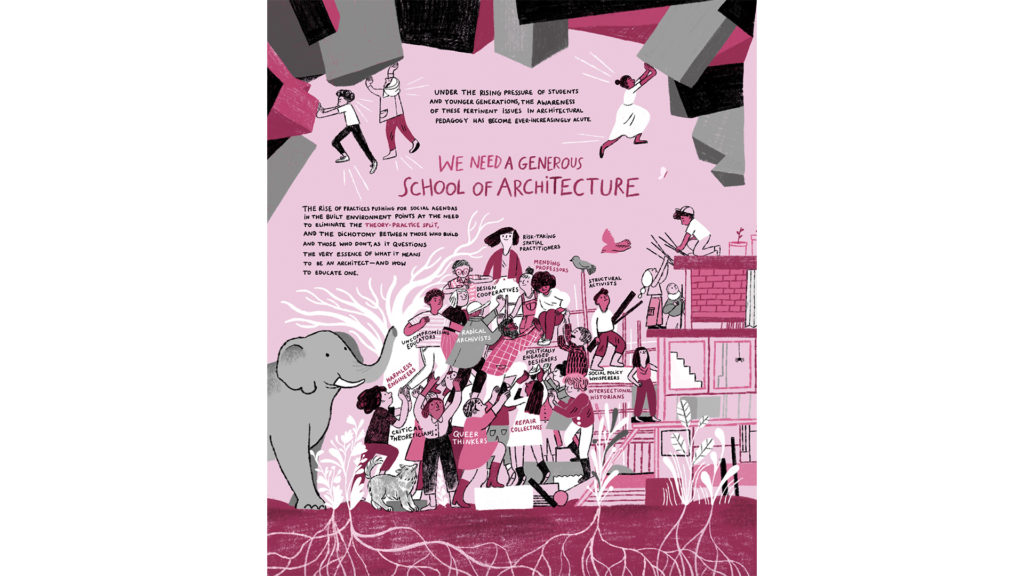
Charlotte Malterre-Barthes and Zosia Dzierżawska, “New Rules” in Learning Architecture, Cartha Magazine, 2022.
I wonder how you see this kind of generosity now, versus when you started with us in 2021? Were there other pieces you edited with Cartha contributors, or moments working with the Cartha team that opened up new avenues of trust and collaboration? Are there other publications, projects, moments or experiences, essays and articles, etc, that you find generous in this way?
I ask these questions also in the context of finding roots for Cartha’s “remains.” As we expect academic and professional institutions to meet the ‘New Rules’, what do we expect from this publication, and others like it? Perhaps not something we can answer immediately, but hopefully work towards as we continue the conversation.
Very best,
Ainsley
…
Hi Ainsley,
I’m glad you mentioned New Rules as I was thinking about that piece the other day. The manifesto “We need a generous school of architecture” delineates a set of radical foundations. Bodies strain to push piles of concrete off the page, and replacing these piles, instead, is a structure dominated not by carbon but by people: a structural activist, a radical archivist and a queer thinker (to just name a few) all climb up a ladder together, extending their arms to build a collective scaffolding towards something brighter.
As you can probably imagine, I have some thoughts about learning and teaching at a US institution from my experience over the past three years. To make a connection to the piece above, I’d like to take a minute to reflect on ‘rules,’ more broadly. Rules to limit the use of physical space for peaceful protests. Rules that strongly discourage the use of certain words. Rules that constantly change without much notice or apparent guiding framework, only to placate whoever holds power at that particular moment. These are just a few rules that have been enforced by countless institutions in recent months, while simultaneously selling students a ‘liberal’ education. Here, rules have been used almost exclusively to create a climate of fear.
By contrast, rules for generosity require strength and trust, just as you say. Charlotte and Zosia’s piece is subversively authoritarian. It fully embodies the feminist killjoy. While dismantling past power structures, the piece sets its own rules for generosity with an almost disciplinary tone. To forge a new path, though, this tone is a necessary one. Fundamentally, these new rules are a series of building blocks to open up possibilities rather than restrain.
Collaboration itself, I think, can be seen as a practice of generous rule-making. When working together, we’ve taken steps to challenge each other’s decisions, set up hopes and dreams, and really consider questions like “what do we want to contribute our time and labour towards, and why?” A piece from the archive that I’d like to bring to the table is Galo Canizares’ Beyond the Cruelty of Software. The more that I think about it, Canizares’ take on generosity could not be more apt as he argues that bringing compassion into design software – one of our main daily collaborators – could shift labour dynamics as a whole from value-extraction to understanding.

Galo Canizares, “Beyond the Cruelty of Software” in Invisible Structures, Cartha Magazine, 2020.
Galo’s is one of my favourite essays to come out of Cartha. As I was not yet part of the team when it was published, I’d love to hear your thoughts on how you feel it stands now and what other essays or moments evoke this type of generosity to you. How can generosity extend to medium as well as message? In the context of Cartha, what types of digital formats could enable Cartha to remain?
There are many more pieces that come to mind, and I know I haven’t answered nearly enough of your questions, but I’ll stop here so we can continue the conversation.
Best,
Holly
P.S. As I’m writing this, Zohran Mamdani just won the vote to be the Democratic Nominee for New York City Mayor. His rules: an immediate rent freeze for stabilised apartments and free bus transit, both vital steps to making life in New York affordable again. Although not entirely related to what I mentioned above, this comes as a refreshing reminder that compassionate and generous political agendas are not only possible but they’re being actively demanded.
…
Dear Holly,
I worked directly with Galo Canizares for his contribution to Invisible Structures, and you bringing it up again made me revisit our email exchange during the editorial process. With Galo I had very little line edits, rather sharing references and thoughts about love, tenderness and pleasure as activism in architecture. I think we desperately needed this kind of collaboration at the time, when doing work was all labour amidst sometimes months-long quarantines in 2020. Time was (and frankly still is) carefully guarded.
To your question: “what do we want to contribute our time and labour towards, and why?”– I am reminded of these kinds of collaborations, more about listening, responding and mutual growth, rather than seeking a means to an end. The futures we build could be an accumulation of smaller structures, and it’s not clear to me yet what that looks like for Cartha, but I guess what I’m saying is maybe we’re looking too far ahead—Cartha is dead and must somehow survive—without doing the listening along the way.
This leaves me thinking about Derek Jarman’s garden. I recently read Olivia Laing’s latest book The Garden Against Time: A Search for a Common Paradise (…maybe you’ve read it already– you introduced me to Laing), where she speaks about Jarman’s influence on her thinking, writing and gardening. Listening to Laing discuss her book with radio host Flo Dill in the podcast “Digging with Flo” by NTS, I learned that Jarman would throw seeds in the wind to grow where they land, and let himself be surprised by ways plants pop up from the shale to protect one another in the sometimes harsh climate of the English coast. An enormous power station nearby originally thought would toxify the area actually provided needed shelter from the intense winds for plants to grow. Planning, at first, was more a wordless conversation between elements, and Jarman was an interpreter.
In her book, Laing discusses ‘paradise’ in gardens, and reflects on the state of Jarman’s garden after he died in 1994: “This place had been the site of so much energy and enterprise, such restless motion, and now it was only a shell… a garden dies with its owner.” She continues, “it can be re-animated in a new form, absolutely, but the tutelary spirit who’d made all this, the old magician on his driftwood throne: he’d left.” I think this spot might be a good place to position Cartha’s remains; reimagining remains as not as a shrine to the original, but rather a place for regrowth, like an ecological succession.
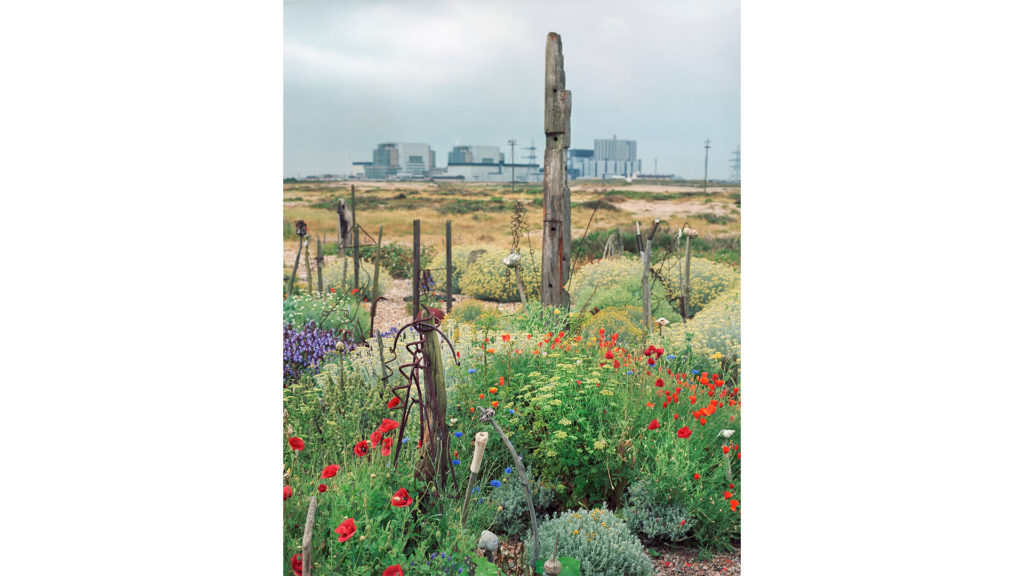
Derek Jarman’s garden with power station in the background, via.
Lastly, an article from Cartha I think finds footing here comes from the Possible Progress issue in 2019 that questioned “progress” as the goal. Julia Dorn’s essay “Fake News From Nowhere; Utopia Against Stagnation” insists on the need for contemporary utopic thinking as a form of advocacy. In part, Laing is doing the same with seeking paradise in the first place, as well as Malterre-Barthes and Dziersawk in outlining new rules to reform education. All three writers don’t shy from the larger patterns of privilege, exclusion and exploitation within, but remain generous in clearly describing what they want to see in the future. Maybe we can make a list of what we want to see in editor/writer relationships, in publishing platforms, in the foundations of sharing knowledge. What do you think?
Be well,
Ainsley
…
Dear Ainsley,
Throwing seeds of Cartha to see where they land is such an evocative image, and one that I think we can take forward in some way. Up until now we have probably looked at the “survival” of Cartha in quite black-and-white terms, and I agree that we need to reframe it. In the podcast you recommended, Laing elaborates on visiting Prospect Cottage after Jarman passed. A seemingly bittersweet encounter, they felt conflicted about the desire to preserve the garden, speculating that Jarman would have encouraged us to “make your own garden, let this one go.” Gardens, afterall, should stand as sites of regrowth rather than stagnation, so preservation seems almost antithetical – much like boxing up an online publication originally intended to create discourse.
I’m reminded of a lecture at Columbia GSAPP back in January, which tackled issues around more-than-human intelligence. Although the full lecture is well worth watching, I’d highlight Laura Tripaldi’s segment (06:50) and Anna Tsing’s segment (57:30). Tripaldi interrogates the “fundamental threshold where materials conventionally considered inert and passive become capable of feeling, acting and learning… when, in other words, does mind end and matter begin?” Building on this, Tsing argues that material form is an archive of more-than-human intelligence. Drawing on examples such as fungi leaving cracks in rocks, she redefines intelligence as the “know-how to navigate encounters.” This made me speculate on Cartha’s archive as form, or as a collection of matter. Can some of the previously published texts feel, act and learn in future? What frameworks would we need to set up to enable these interactions and let them stay current? What forms would take shape as a memory of these encounters?
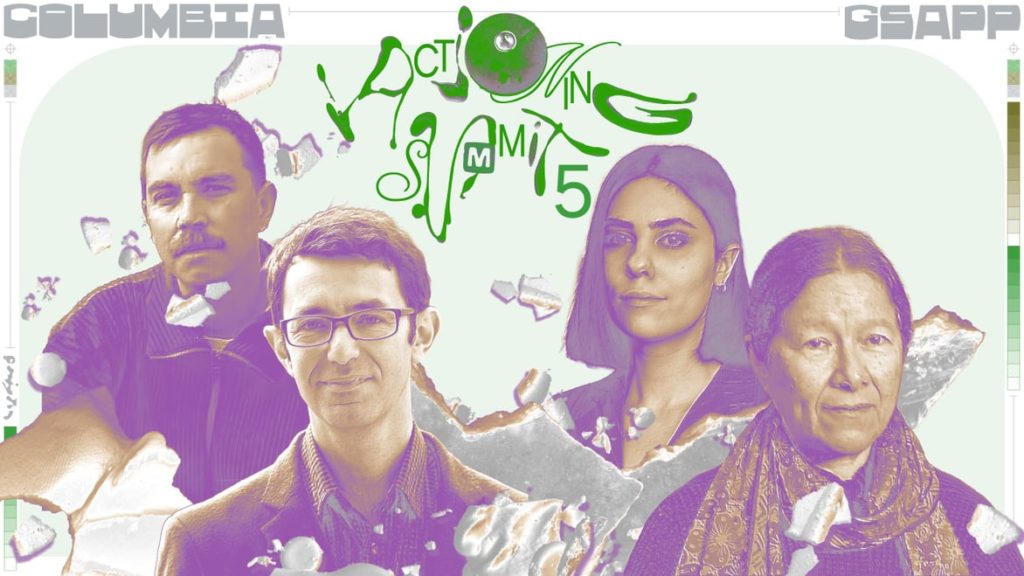
Columbia GSAPP: Actioning Summit 5, How to think through/as more-than-human intelligence? with James Bridle, Michael Marder, Laura Tripaldi, Anna Tsing. January 27, 2025.
On the subject of utopias, thinking about our futures often requires a look to the past. Tsing discusses “world-making” where respect for non-human intelligence is a way of living with things that aren’t technologies, that aren’t human design to help to make worlds with us and around us. I don’t believe that we need to negate technology in order to co-exist with the natural world, because even technologically-aided design – when applied with the right sensitivity – can often have enhancing and synergizing effects with that very world. To this end, a friend of mine introduced me to this short text when we were working on a project about data storage. Ursula LeGuin is one of my favourite sci-fi writers, and you may well have read it already: The Carrier Bag Theory of Fiction. In essence, the carrier bag is seen as one of the first cultural devices; both a tool for collecting berries and seeds, and a technology developed as a system of material knowledge. The container enabled both collection and storage so humans could plan for continued sustenance and, subsequently, carve out more time to do other tasks beyond gathering in the future.
Perhaps I’ve gone a bit off course, but I guess I’m trying to lay out some definitions of an archive. Let’s say, if each piece in the collection is able to create new conversations each time someone different reads it, then how much of the archive do you even need to curate? You must come across this phenomenon quite a bit being a curator yourself – how do you balance the need to mediate thought vs. letting discourse take a more “natural” course? Perhaps algorithms could be helpful in this context – imagine if each time someone visits CARTHA’s page, they generate a sentence paired with an image from our archive, sparking a new relationship in the process? Or better, if the webpage ceases to exist, Cartha becomes an excel list, a repository that contributors can share references and continually add to. Expanding this definition of an archive has felt important, but maybe now we should give the list format a go, as you suggest. Finally, before I get even more carried away, Le Guin concludes in her text in a rather fitting way to some of the themes we’ve been exploring – she writes that the story isn’t over: “Still there are seeds to be gathered, and room in the bag of stars.”
Best,
Holly
…
Dear Holly,
It’s interesting how parallel conversations find points of connection— very much the Carrier Bag way! Every year I give my students this essay as their last reading of the semester, and together we discuss the implications in space, time and ecology. For many, it’s their first exercise in developing theory in architecture and design, so the resulting thoughts are wide-ranging and always intriguing. I play an excerpt from “Crafting with Ursula: Lidia Yuknavitch on The Carrier Bag Theory of Fiction,” an episode of David Naimon’s podcast Between The Covers: Conversations with Writers in Fiction, Nonfiction and Poetry, where they paraphrase parts of a keynote discussion titled “What Could a Vessel Be?” by Christina Sharpe for the 2022 Venice Biennale of Art. The narrators ask questions such as: “what is a vessel in times of refusal or resistance; is a vessel a reimagining?”
One of the student groups this year suggested that vessels are instinctual. They insist that the vessel is a verb that, by its very nature, builds new worlds and conditions. I believe it as well, that Cartha, and publications like this one, are vessels that do just so. Driven by a comparatively sincere interest in writing, collaborating, and developing new ideas—sincere in the sense that there is no immediate measurable value gained— the works we publish are hardly resolute. They are aimed at expanding the yearly topic for ourselves, or guiding writers into new and unpredictable thought formations, and hopefully, shaping positions in practice to continue impacting discourse from the bottom up, and spiralling out.
In 2023, you and I led a seminar for Unmasking Space at the ETH Zurich, where we reflected on Cartha’s editorial process from ideation to publication in the context of the yearly topic, Learning Architecture. It’s worth resurfacing: firstly for the sake of expansion, considering what we know now in comparison to what we knew then regarding preservation, memory, collaboration and compassion in publishing and editorial work, as well as for the purpose of recording a process that is structured to grow; to produce something new through its use.
Black: original framework 2023
Blue: adaptations and expansions 2025
Bold: outputs
Italics: contributors
↔ / →: feedback
Initiation: editor ↔ editor
inquiry
workshops
green messages
blue ticks
gathering seeds
positioning
departing questions
generous rule-making
summary
call for papers
temporary web page
↓
Curation: public → author ↔ editor
RTFs
reading
shortlists
reframing
selecting
shared links
emails
track changes
version history
throwing seeds
↓
Reception: author ↔ editor ↔ public
editorial
issue
material form of PDFs
↓
Archive / Memory: public ↔ public
sharing
bookmarking
conversations
a vessel?
regrowth
Rather fittingly, we conclude this exchange in collaboration. The listing resembles a script to be played, executed, hacked, manipulated and diverted from, both documenting our process and providing a structure to build upon as the needs of architectural publications change over time. The stages of production may shift or overlap, they might become obsolete, or, in the case of this latest issue, “archive” might cycle right back to “initiation.” The listing lays out the contents of our bag, an act we hope is generous enough to flourish.
Sincerely,
Ainsley and Holly