Giovanna Borasi
emailing with Francisco Moura Veiga
Dear Giovanna, What I would like to discuss with you in this relaxed exchange is timeliness. More precisely, the timeliness of knowledge. Back in 2010 you curated the exhibition “Journeys: How travelling fruit, ideas and buildings rearrange our environment.” I do not know of its impact on a broader audience but it definitely struck a […]
Dear Giovanna,
What I would like to discuss with you in this relaxed exchange is timeliness. More precisely, the timeliness of knowledge.
Back in 2010 you curated the exhibition “Journeys: How travelling fruit, ideas and buildings rearrange our environment.” I do not know of its impact on a broader audience but it definitely struck a cord with Cartha, leading us to invite you to contribute to our “Cartha on Making Heimat” (2016) to talk about migration from a slightly different stance.
While the topic of migrations was a very present one in the European context in 2016 due to the steep increase in the influx of people as a result of the conflict in Syria, looking at architecture through a journey’s lens in 2010 did not feel too obvious. Was it somewhat of a gamble?
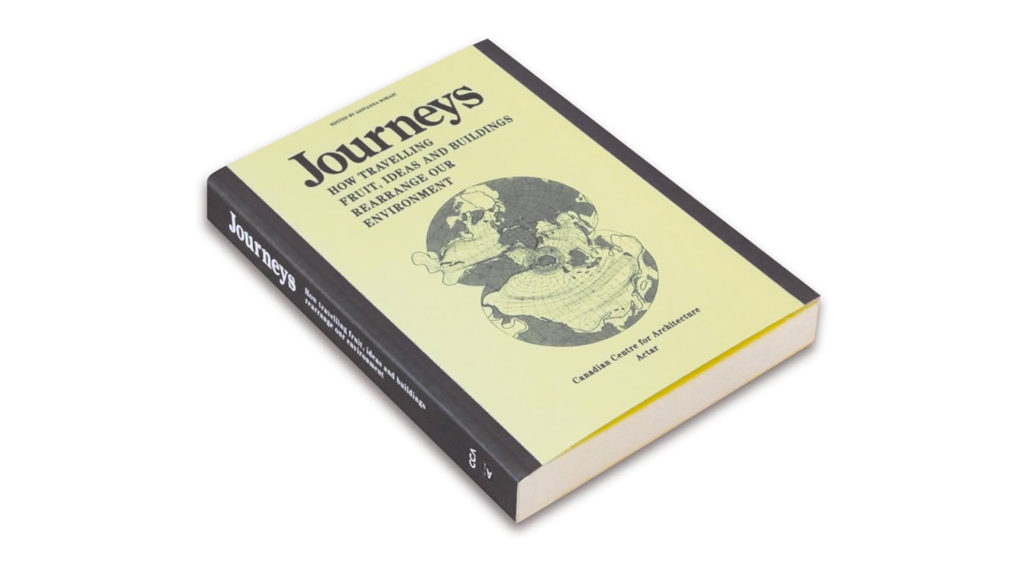
“Journeys: How Travelling Fruit, Ideas and Buildings Rearrange Our Environment”, Ed. Giovanna Borasi, Actar Publishers, 2011.
I have to say that it is not my intent to place curatorial and editorial practices explicitly within an attention economy frame but it would be dismissive not to mention the reality that knowledge production and archiving institutions find themselves in: no audience means no purpose. I was surprised to learn that even early institutions seem to abide by this silent rule: in their transition from the Greek to the Roman context, through Epictetus, stoic philosophy underwent a subtle change in its narrative in order to accommodate a “results mindset” Romans seemed to have. Instead of focusing on a broad search for A Good Life through personal virtue, through logical thinking, and physics enquiry, stoic tutors focused instead on Tranquility, a more tangible, more immediate outcome that a stoic approach could bring to their students’ lives.
Funnily enough, with the rise of Christianity, stoic schools seemed to die out. So much so that, writing his “A Guide to The Good Life” in the early 2000’s, William Irvine–a learned philosopher–said he had never come in touch with stoicism throughout his studies. I guess stoic tutors failed hard in spinning their narrative off in a way which would be in tune with the late Roman empire’s Zeitgeist.
One might say that the choice of topics or themes will always result from the cultural context one is inserted in, what might imply as well that any topic would always be aligned with broader contemporary interests but then how to explain the dying out of stoicism?
In later curatorial initiatives, such as the series of movies you have been producing with the CCA, you touch topics you defined as, and I quote from your presentation at the Arquiteturas Film Festival in 2023, “being relevant for the future.”
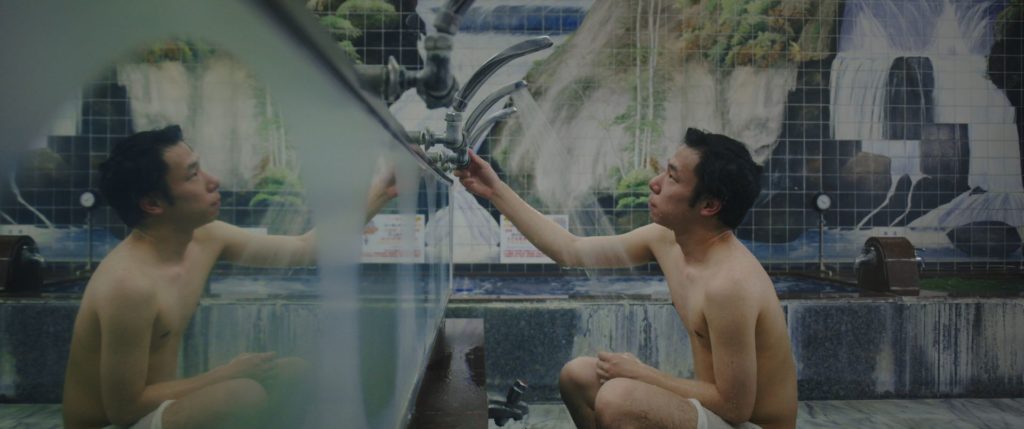
Movie still from When We Live Alone, a film conceived by Giovanna Borasi and directed by Daniel Schwartz, 2022.
How do you position yourself in this timely dance between your interests and the relevance a topic might have for a broader audience?
Is being somehow in tune with the present, with the future defining of your curatorial decisions?
And why?
This would be the first email of our penpal exchange. The idea is to have the back and forth for a couple more emails, always using links to internet elements as anchors for the discussion.
I don’t expect you to ask me questions but do feel free to reply in a colloquial, dialogical manner. This should not be read as an interview.
I hope you have fun with this!
All the best,
Francisco
…
Dear Francisco,
Thanks for your email and prompt.
Thanks also for resurfacing, for me and our readers, the exhibition and publication Journeys. It is still one of my favourites. Besides the toughness of the subject it touched, it tried to open up to the positive and creative impacts of migrations. Migrations of people, animals, fruits, vegetables, stones, and more, but mainly of ideas, ways of doing, ways of building… it was about how, with all these different movements, knowledge travels and meet others, and then what happens next.
The question of the timeliness of knowledge is a very interesting one. This is maybe what cultural institutions deal with the most. Creating and sharing knowledge to be a reference and a forum for the long run. At the CCA we think about this, in our own way.
Our centre is often positively ‘trapped’ between two things:
On one side, the necessity and the ambition to be contemporary, in order to be able to stay relevant and be part of the discourse of architecture. Understanding the ‘now’ and what to think about the issues that are pressing today. We often do it through identifying what we call the ‘gray areas’, overlooked and apparently tangential issues that we think will become crucial in the years to come. We do not limit ourselves to looking at the field of architecture, but rather we see society as a whole through the lens of architecture. We also understand contemporaneity not just as present issues but also as a contemporary way of seeing past issues. See, for example, how 1973: Sorry, Out of Gas, a CCA exhibition and publication, focused on a past crisis (the 1973 oil crisis) and learned from the environmental and ecological responses by architects and thinkers as a future that did not take place. At the same time, we understand the notion of contemporaneity along the lines of the Italian philosopher Giorgio Agamben’s understanding of it: to be contemporary you need to be a bit off time. Earlier or a bit dated. In a way not fully aligned and synchronized with the today. If you’re too in synch with the present, your ideas will already be absorbed and shared by time you articulate them. But if you’re contemporary insofar as you’re a bit ahead or a bit behind, according to Agamben’s definition, you could actually surprise your visitors and readers. But you also risk to not be fully understood.
And, on the opposite side, CCA would like what it puts out to be understood as a long-term reference and not a quick and responsive answer to the now. The pressing, overlooked, and gray areas are chosen because we see in them the potential to eventually go deeper in researching them and appreciating them differently.
You could say the CCA works in a circular way: selecting a pressing issue, thinking about it differently, sharing it… hopefully having impact and changing the way things are thought about, and then society is changed and brings up a new issue…
So, going back to your initial question: was picking migration as a topic in 2010 a gamble, considering that the subject did not yet have the momentum of the massive migrations happening shortly later? I will certainly say no: migrations were already and have always been happening, and my goal was to start to look at them not only as a human crisis event, but as a process of interplay between diverse and foreign ideas, ones we could learn from.
All the best,
Giovanna
…
Dear Giovanna,
The place the CCA, and you, find yourselves “trapped” in is not obvious.
One has to search for it and want to stay in it. In other words, it is a productive edge that needs to be built and maintained. And, to put in overly simple terms, what is produced is an “otherwise” take on reality. As you said, it acts by “hopefully having impact and changing the way things are thought about, and then society is changed and brings up a new issue…”
I am interested In this causal relation between sharing knowledge and changing society. I find it crucial.
One of the theories I am currently looking into in the frame of my doctoral research on architectural pedagogy is the “conceptual change theory.” It was initially postulated by Posner, Strike, Hewson & Getzog in 1982 but I find Stella Vosniadou’s refinement of it to be more enlightening. The theory holds that meaningful learning occurs when learners replace or reorganize their existing mental models with new ones that better explain phenomena, often requiring a shift as deep as a scientific paradigm change. A good example is kid’s perception of a pullover: when it is cold, we tell our kids that they should put on a pullover to get warmer; they do so and feel warmer. It is easy to understand how a child might think that the pullover is warm. We know this is not so, the pullover insulates as it has inert gases trapped in its fibres. But how can we surely update the child’s misconception? A series of sequential steps is necessary.
- Destabilize prior knowledge through misprediction of behaviour – show that the pullover is not warm: take 3 ice cubes, cover one with a pullover, the second with a wet cloth, and the third with aluminium foil. Ask the child which cube would melt first. After a couple of minutes, show the results.
- Input of updated knowledge – the ice cube covered by the pullover will, obviously, melt slower. Now is the time to explain that the pullover insulates, it does not warm up.
- Metacognitive reflection – Ask the child to go over the experiment and to make a sense out of it, to predict how the pullover would act on something else.
The efficacy of this approach has been measured and attested, it “works.”
What are your ways of knowing the impact of the exhibitions, publications, movies you produce? Is this something you consider?
If not, can one point out to a causal relation between sharing knowledge, society’s change and it in turn bringing up a new issue?
Or does this change happen rather in the knowledge producer’s perception of society and the need to move on to the next one?
Wishing you all the best from Lisbon!
Francisco
…
Dear Francisco,
Thank you for your latest message. As you said, staying constantly on a productive edge is definitely no easy task for any organization.
You want to be understood and at the same time not to sound too obvious.
For us this is directly connected with the aim of having an impact; and what I mean is not about having an impact for the sake of impact, but as a way to carry out our mission, which is to “make architecture a public concern”.
So, as you are pointing out, sharing knowledge and changing perceptions are tightly connected. And there’s a way to involve people, rather than just telling them the answers. This is why the CCA’s exhibitions are research based: we start from a preoccupation or a question we ourselves have, because, like the kid with the pullover you’re referring to, something we take for granted doesn’t quite make sense to us in the way it’s normally talked about, and we’re consistently driven by the curiosity and a quest to find out what’s going on and look at it in a different way.
The output of this process (be it an exhibition, a film, a publication, etc.) is just the tool to share the insights we have gained through delving into the potential answers to our questions. And that leads often to more questions, which is of course the hope.
You mention how the impact of the pedagogical approach involving those three steps, of destabilizing knowledge, inserting new knowledge, and inviting reflection on that shift, is measurable, and measured to be effective. I’m not surprised, but that kid with the coat and the ice cube is a distilled and elegant illustration. I will say it certainly resonates with how we approach curation at the CCA, but when scaled up and oriented to complex and dynamic societal issues, it becomes very difficult to measure the impact. But that is the beauty of being exposed to complexity or being with open eyes toward the world: you never know if reading a book or watching a movie in a cinema will suddenly shift your understanding and perception on things. Those forms somehow invite a focused relationship; they can be more like the pullover. With exhibitions it is more complex, because, unlike sitting down and reading a book in privacy, visitors to an exhibition enter a space, share it with other people in it, all meandering through it by different paths, along with the precarious timing of it all… it effects how you process what’s being presented to you.
We do receive feedback, but often it is anecdotal, not to say insignificant. Not at all. For example, Colombian architect Giancarlo Mazzanti shared with us that he changed the way he conceived the hospital he was designing because he had read Imperfect Health: The Medicalization of Architecture, the 2012 CCA/Lars Müller publication that I edited with Mirko Zardini accompanying the exhibition of the same name we co-curated: his gesture of adding healing spaces, nature, views in the patients’ rooms, a ground floor that does not smell like a hospital but that is friendlier and not a scary space but rather a community place for the neighbourhood, was informed, in his opinion, by our research and the proposition to not think of medical space as part of a “cure” but as part of an act of care. It’s not a “measurement”, but feedback like this is meaningful because it’s concrete, it doesn’t require translation; it shows for me the role that a place like the CCA could have in the world. Or at least with the architects, the decision makers, the ones who build space … and then citizens and users will be affected by those decisions and spatial solutions, to the point that they will also share their experiences, perhaps while sick (if we continue to use the hospital example) of a different kind of medical facility.
Now, clearly, in our curatorial work there is ultimately this intention. Again, this is our mission, and when we look at examples like that, we can start to look at it from different angles: how we make architecture a public concern, how we ensure the public will be concerned by architecture, how we make architecture concerned about the public, and so on.
Ultimately you have a responsibility: if as a trusted organization you are pointing to a subject, people will think it is relevant. So, in that simple way, you are provoking attention to something, and then ultimately knowledge about it.
On a wall in the institutional entrance at the CCA, seen by our staff but also by all our visiting collaborators when they arrive to undertake their work here, there is in great big font an amazing quote by Gordon Matta-Clark: “Here is what we have to offer you… Confusion guided by a clear sense of purpose.”
This quote, from 1973, is in his archive here, but it also summarizes the CCA very well. The key element is the sense of purpose, the affirmation that it’s important to jump into confusion sometimes. It loosens hardened assumptions, making room for deeper stability. And if you have that and people also grasp it, you will have the impact you are looking for.
Ciao,
Giovanna