Meg Miller
emailing with Ainsley Johnston
Hi Meg, With this year marking Cartha’s last official issue, a perhaps obvious question at the top of my mind is: what happens to ten years of online essays when we don’t keep up with website maintenance? Just the other day our wordpress administrator asked to be removed from our account from too many spam […]
Hi Meg,
With this year marking Cartha’s last official issue, a perhaps obvious question at the top of my mind is: what happens to ten years of online essays when we don’t keep up with website maintenance? Just the other day our wordpress administrator asked to be removed from our account from too many spam emails. We’re on our own! Bound for ArchiveTeam’s Deathwatch!
Besides your work as an editor at Are.na, your personal writing pieces such as Metaphorically Speaking for Dirt and A Shimmering with Mariah Barden Jones for the html review make me think that this is a question you have considered before– in different constellations of storytelling and research, and in ecological and technological dimensions.

Meg Miller and Mariah Barden Jones, “A Shimmering” in html review, Issue 04, Spring 2025.
Which brings me to starting off our pen-pal-ship with one of my favourite essays I worked on with Cartha, a piece by Lena Appel called Mainstreet is Almost Alright: Repeat to Delete. The issue, Invisible Structures, came from an interest in exploring the nuances of visibility in the realm of architecture and space planning– a discipline heavily reliant on visual order, yet largely determined by unseen forces. In each Exposure note Lena provokes questions that architects overwhelmingly underestimate: how much space does acceptance, desire, memory, decay and scent take up, even if for a brief moment?
I continue to return to this ‘spatial residue’ I’ll call it, what Lena observes as evidence in the leftovers of events, such as sillage in perfumery, her mother’s image of her grandmother “dancing happily in the kitchen,” or the bags in Exposure note 4 that “were part of a rotating system structuring the days.” Lena also makes some beautiful reflections on the differences between “archive” and “storage,” where Cartha is now at a point to find a new life in one or both.
Thank you for agreeing to participate in the project– I’m excited to think on this with you. Feel free to comment and connect to other articles, essays, images etc from anything here that might resonate.
All my best,
Ainsley
…
Hi Ainsley,
It’s nice to hear from you, and nice to have a new pen pal. I really miss this mode of exchange. A friend and I were just talking about a “pen pal girl archetype” and how we both felt like we fell into it, even though we hadn’t had a pen pal since childhood. I love all kinds of letters and cards and long-winded emails and voice notes, but this feels particularly special since we’ve never met in person and we live in different parts of the world, but we seem to have a lot of commonalities between us. In other words, we’re doing pen pal right. We’re pen pal purists.
This piece you sent by Lena Appel is so interesting, I hadn’t read it before. I was especially struck by the drawings of her mom’s stolen jewelry — a memory replacing the real thing, and then becoming more real than the original. I think a lot about memory and forgetting and about these sorts of stand-ins for the things we’ve lost. The things that mark a presence of an absence, in other words. You mentioned my piece “Metaphorically Speaking,” where I write about the notes that my mom left behind as extensions of her mind, the reminders that gave structure to her life as her memory was receding. Which are now reminders for me, a part of her internal self made concrete, accessible to me where she is not.
It’s interesting to think about the digital remains of a publication. If we’re around the same age, I’m guessing you were warned ad nauseum about how what you put on the internet will be there forever. Some of it does seem to never go away. But more and more we’re seeing that without maintenance and care, entire platforms and archives can easily disappear (even with impressive efforts like The Internet Archive’s Wayback Machine). Kaloyan Kolev recently wrote a piece for me at Are.na about a popular Bulgarian video-sharing platform that was taken offline, and whose content — a lot of which was very personal, very cultural, and made up a big and beloved part of the Bulgarian digital media landscape — would have been erased forever if not for a group of volunteer digital archivists. I also worked as an editor on Century-Scale Storage by Maxwell Neely-Cohen, a long and incredibly thorough (and way more riveting than you’d assume, given the subject) essay about the problems with digital storage and longevity. One point he eventually comes to is that no matter the technological solutions we come up with for this problem, we will also need to build an infrastructure around it of people and institutions invested in continued maintenance and preservation of our digital data — much like we have now for print archives and libraries.

Maxwell Neely-Cohen, Century-Scale Storage, Library Innovation Lab at Harvard Law School, 2024.
I’ve also worked on a web publishing project that takes an entirely different approach to digital archiving. The Life and Death of an Internet Onion is/was a pandemic-era web-zine that Laurel Schwulst made with her students about the possibilities of love online. From the beginning, we envisioned it as a perishable publication — each issue was online for 5 weeks, the typical lifespan of a non-refrigerated onion, before rotting (the website got increasingly blurry every day) and then disappearing totally. But like an onion it was also perennial, coming back each year with new layers full of fresh new writing. When the archivist Cori Olinghouse wrote about the project, in a piece titled “What if we let archives die?” she said that this decaying gesture is what drew her towards it. “Temporalities animate life. Marked by endless scrolling, so much of the internet feels like ‘dead space’ with no sense of time passing. Similarly, archives can also feel like places where things go to die.”
Anyways, these examples are hard to compare, the stakes are different. But I’m curious if any of this strikes a chord with you, and what you’ve been thinking about while preparing for Cartha’s digital end.
Sorry for going on for so long!
in the meanwhile,
Meg
…
Dear Meg,
I’ll gladly accept your long email—and double it. 😈 Strap in! What’s a pen pal letter without some slow storytelling, meandering thoughts built up and dismantled and reassembled, precariously held together enough to ask: so what do you think? With my last pen pal, this would have been done with stickers and scented markers. I’ll try to make it as snazzy.
I discussed Kaloyan Kolev’s piece that you shared with a couple of CARTHA editors as we decide what happens next. It inspired me to become a DIY-code-hacker-python whiz and at the very least scrape the PDFs from our website that we’ve published since 2015. For now, this content sits in folders on my computer.
I find your references so human. I love them. The topic of archiving is so often framed as institutional or operational. Maxwell Neely-Cohen’s piece “Century-Scale Storage” makes me question: what is Cartha, exactly? I think a collection of PDFs in a folder on a hard drive, or in the cloud, doesn’t cover it. The PDFs are the material evidence of what’s left—if we count PDFs as material. For me, they feel like a white glossy acrylic rectangle, or an ergonomic memory foam pillow. Rigid, but in a satisfying, supportive, dependable way, with a nice texture, but certainly not compostable.
Cartha allowed me to meet so many interesting people. It gave me a reason to cold call somebody just because I like their work and want to get to know them :-}. Essays and editorials provided connection points, but the email exchange and editing process changed the way I write and think and collaborate. I grew a deep friendship with a fellow editor over our desire for consistent and careful collaboration—next week I’m heading to her wedding. I worked on this project for six years for free, but it opened doors and gave me jobs. Editors came and went, and we moved cities and had babies and started architecture firms and PhD’s, and a few of us stayed throughout it all, despite being obviously overextended. It was clear a few years back that the platform needed to adapt to the realities of the cost of labour (time + money), but capacity to take that on was limited. In that sense I think we (the editors) collectively agree: we’ve long accepted the end would come.
Looking past PDFs-as-evidence, I think the foreword and editorial of On Relations, Cartha’s first print publication that came out of the inaugural online issue Relations in 2015, is a good reference (attached). I wasn’t part of the team at the time. I joined them in 2019 after sending one of the founders, Francisco Moura-Viega, a DM on Instagram about a different project entirely, and he asked if I wanted to be an editor instead. Admittedly, I didn’t know who they were. I read On Relations in the library sitting on one of those trendy pillowy armless floor chairs, and decided, quite easily, it would be something I’d enjoy being a part of. In the foreword, Rebecca Kiesewetter asks for “empathy and friendship to become the base and direction of publishing work,” and reflects on Cartha at the time as unique in their hunger for experimental and heterotopic forms of thought production, at least in the realm of architecture publications. In the editorial of the chapter “Worth Sharing,” CARTHA sets the goal of generating synergies and fostering cooperation in their work, borrowing from architecture’s dependency on systems of coordination between teams, practices, knowledge and information needed to build buildings.
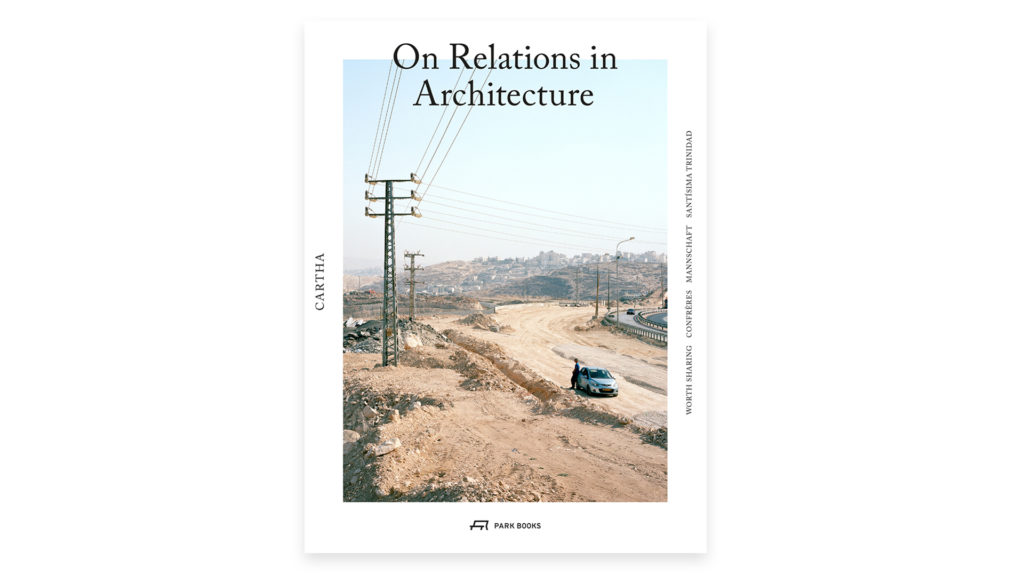
Elena Chiavi, Aurélien Caetano, Pablo Garrido Arnaiz, Matilde Girão, Rubén Valdez, Francisco Ramos Ordóñez, Francisco Moura Veiga, eds. On Relations. Zurich: Park Books, 2016.
Without fully being conscious of it, I resonate with that goal now 10 years later. I think it ties into Neely-Cohen’s century-scale storage infrastructures built on care, and in this case, the desire to connect meaningfully and with a collective purpose, against a sea of architecture publications pushing big names and large markets—a concern also highlighted by How to: not make another architecture magazine at the Canadian Centre for Architecture in 2018: “Publishers delude themselves into thinking that they’re playing a cultural long game of changing the discourse. You’re not going to change the culture at Gensler by putting an article in front of them, it’s by forming a union.”
The outcome of each yearly issue was unpredictable, and I still don’t fully know the impact it has on readers. We don’t keep any metrics, and most of our audience is in Europe, where I am not, so I don’t overhear it in passing. We do keep a list of contributors, who, like us, shared their time and energy out of pure interest. If anything, our continued presence lasts in their collective investments. I hope we’ve also helped them get to where they wanted to go.
As usual, feel free to expand on anything that speaks to you. I’m interested to know: as a writer, editor, contributor and collaborator yourself, how do you imagine an online publication beyond the PDF (material evidence)? What sort of relationships move you and make your work worth it?
Sending warmth 💌 from the library 📚 eating a banana muffin 🍌,
Ainsley
👩💻< me coding
…
Dear Ainsley,
I really enjoy where your mind went from the pieces I sent. And as for your first question, I think about this all the time. I think about it especially at this time of year, when I’m wrapping up edits for a yearly anthology we publish at Are.na, called the Are.na Annual. All summer, my co-editor Amirio Freeman and I have been going through submissions, commissioning pieces, meeting with writers to shape their writing, and doing rounds of edits. The book is themed — this year the theme is “pool” — and there is always a lot of effort to make sure the pieces are coming at it from a bunch of different angles. But I’m always surprised, in the end, how they all end up overlapping and speaking to each other in these very nuanced, specific, and unexpected ways. There are always elements that you can’t plan for — that a piece on vernal pools would touch on the same underlying themes as a piece on carpooling or the gene pool, for example — and it’s always so fun and exciting to see it all come together, to identify the broader threads that run throughout as well as the smaller dialogues between the pieces that only reveal themselves once we’ve brought them in relation to each other.
More than anything, this is just a reminder to me that publishing is at its best a generative process, where ideas and references are shared and put in dialogue with each other in the hopes of producing something that is collective and new. I recently edited A Sexual History of the Internet by Mindy Seu, an artist book that documents a performance by the same name, and in her introduction Mindy talks about how all books are publics, “built from references, quotes, and ideas from others.” Mindy’s book experiments with a new redistribution model where everyone cited in the book gets a share of the profits, which I find to be really interesting as a feminist theory of citational praxis made material. But this idea of a book being a public, or publishing being a way of assembling a public, also speaks directly to my own personal philosophy of publishing.
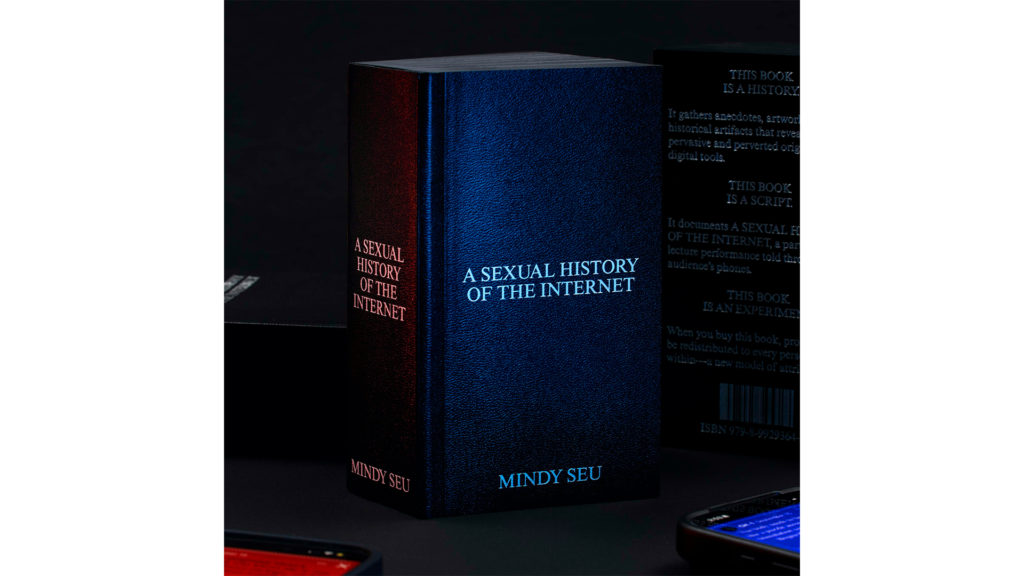
Mindy Seu, A Sexual History of the Internet, published by The Dark Forest Collective, 2025.
Another way of saying it might be that publishing is “an act of creating new/alternative networks and communities,” which is language that I lifted from an essay by Felipe Becerra about the artist, writer, and publisher Ulises Carrión. Carrión was a major figure of the mail art movement in the 1970s, and Becerra talks about how, through his bookstore in Amsterdam and his magazine Ephemera, Carrión was the organizer of a particular “social body.” I also love how you put it, that publishing is about relations, about the people who contribute and their collective investment. Publishing is such a collaborative process, always — but that’s especially the case when putting together a magazine or anthology. You’re bringing together writers, designers, editors, illustrators, and photographers just to make the thing. Contributors are bringing in all of their references and influences and ideas. And then the audience comes in, the readership, a disparate group of people who are interested in some of the same things. Ideally the publications are distributed, passed around, lent to friends; they’re wedged between other, similar, books on bookshelves, read years later; they traverse time and space. Or, yeah, they live as PDFs on drives or websites on servers, are passed as links and attachments. But I think they definitely also live on in the minds and memories and collective knowledge of the people who made them and the people who read them, a legacy that’s not so tangible but is probably most of the reason we decide to do this work in the first place.
One thing this has made me curious about is what other publications you feel like Cartha is in conversation with. Were there any that you were looking at with particular interest while you were publishing, or that you think will be carrying on similar themes and discussions after you’ve stopped?
…
Dear Meg,
Apologies for my late reply, I was wrapped up in teaching commitments at the start of the semester. Totally boring excuse, but I bring it up because of your question about other publications in the world of Cartha. When I started with the team, I was deep in academia and craving work written to invite readers and their interpretations, rather than to isolate and narrow thinking as it so often feels like with academic writing. Cartha’s entire team regularly teaches (in Switzerland, Portugal, USA and Canada), and the publication became a way to free ourselves from institutional baggage. We wanted to platform opinions in architecture (shock!) in relation to a topic, and bring new or emerging writers into conversation with some more established writers/architects like Kenneth Frampton, Charlotte Malterre-Barthes, MOS, and Grafton Architects, for example. The responses ranged in tone, but the best were always the ones that created their own rules: like Brown Bags: Sincere Fun exhibit in Winnipeg, where the writers instructed me to turn the gallery into a picnic, and we invited artists and designers from Winnipeg, Toronto, Zurich and Chicago to sit and eat some ~interesting~ recipes while discussing queer architecture as we recorded the event. I had invited the entire Faculty, and about six people showed. The picnic blanket kept ripping and swelling in places from the mysterious draft in the room. I tried to give jello to a vegetarian. What was supposed to be a “lunchroom” after the event was left empty minus some garbage. I’m quite certain the audio cut out for about ten minutes in the middle, so the recording was basically useless. I kept thinking the project was a huge failure, but the writers insisted that was a good thing, a real Jack Halberstam’s Queer Art of Failure. In that way I think we’re failing somewhere between an aspiring Avery Review, or if Log were a zine.
I find a lot of inspiration in your thoughts on books and publishing as ways of assembling a public. At its best, I would like Cartha to exist in The Undercommons: critiquing the institution from the inside, amplifying unheard voices– but ultimately shifting into some other state according to public need. There might be a jumping off point with Brown Bags: Sincere Fun, in that we were grappling with our work as labour in the most conventional sense, where the topic and projects within were an experiment in having fun as an act of resistance. We reflected on the ability to have fun as both reliant on a social condition to permit the act, and a space to house the act. For Cartha to exist at all relied on these conditions, but they are always adapting and require new forms.
So far as publications/publishing go(es), I see these new forms in the work of Are.na and its branching projects like the Synthetic Ecologies Compendium, where bookmarks are made public; as well as in the format of a newsletter like Dark Properties, where knowledge is shared in a way that feels personal; and in the independent bookstore, where you stumble on new publications and authors almost always accidentally. I picked up Paperside’s Bookshop Guide at the Librería Casa Bosques in Mexico City, and it has informed the way I visit cities— walking from one bookshop to the next until the day is over, always packing my bag too heavy with unexpected finds, and in doing so, borrowing from your Felipe Becerra reference, building alternative networks and community through the process of gathering. Of course as an architectural thinker and a city girl, I can’t help but be excited about publishing as a city-scaled experience, like a literary metropolis, a long walk anchored by independent bookstores and soundtracked by Roll the dice by Smerz.
New Forms of Fun Publishing: somewhere between personal messages, public assemblages and walking methods.

Serpentine Synthetic Ecologies Lab, Synthetic Ecologies Compendium, Season 1: Microbial Lore, 2020.
For me, the pen pal format fits within this constellation, and is definitely something I will continue thinking about beyond the scope of Cartha and this final issue—thanks to your generosity in sharing your ideas, references and time! with a complete stranger, and matching my passion for composing thoughtful emails. Your response will be the last of this piece. I think it’s an exciting end point for this publication, which is a tall order for an ending, something of a fertile epilogue. Where do you stand on the role of an ending: do you like songs that fade out or end abruptly? and movies that have resolved conclusions, or much left for interpretation? a cliff hanger? a perennial?
roll the credits,
Ainsley
…
Dear Ainsley,
Now I should apologize for my delay! But something in your question about endings is making me think about the durational quality of epistolary writing, the elasticity that letters give a conversation to unfold across distance and time. Maybe it’s too obvious to point out, but corresponding in this way with you is so different from most of my daily correspondence, which happens rapidly over text, video call, quick emails. I appreciate the slowness of this exchange, the special quality of attention that it affords, the chance to sit down and articulate my thoughts and read and re-read yours. I don’t think either of us should be sorry for the time it takes.
In the weeks between receiving your letter and writing this one, I interviewed Vida Rucli of Robida Collective for a new series we’re publishing on Are.na about spaces for learning in public. Robida live and work in a village of 25 inhabitants in the mountains that border Italy and Slovenia. The village is called Topolò in Italian and Topolove in Slovene. They host a summer school and several different residencies there, and a lot of their thinking has to do with space and this concept of “total hospitality” — how the home can open up to others, be a place of movement, expand into the village and the forest around them, etc. Robida has a longstanding yearly publication, also called Robida, and a relatively new radio project, Radio Robida. Vida talked about how both of these projects — the print and the broadcast — were conceived of as ways to keep in touch with their friends and collaborators from their small, remote village. She talked about how radio and print work on different time scales, one more immediate, intimate, and conversational, the other more complex, involving multiple moving parts, and put together over an entire year. I loved her way of thinking about publication as a method of correspondence, a “concrete way of nurturing far away friendships and building new ones.”

Robida Magazine, from 2015. Radio Robida, from 2021. Image from their website: robidacollective.com.
Anyways, this conversation with Vida made me think of your New Forms of Fun Publishing and gave me the excited feeling of a new beginning rather than an ending. We started off our correspondence talking about archives and how to best preserve Cartha after it stops publishing. Now we’re talking about new forms and scales of publications. This is how it goes: things end to make way for new things to begin, life happens in seasons and cycles. Or maybe better to picture a spiral, new things always building on the old and expanding outward. At any rate, I think I’ll choose perennial for my preferred ending, which is not an option that would have necessarily occurred to me prior to this conversation. I’m grateful for the time and space that this pen-pal correspondence gave to allow this thinking to unfold.
excited to see it published,
Meg