Bridging the Gaps
Atelier Angular
Context Any social, cultural and academic intervention, for its good comprehension, needs a context. The context of what we are developing it‘s our own background, it lies within our society. We are facing a fast shifting and quality decreasing panorama in our country. There’s a clear constant process of decaying in the population’s labor conditions, […]
Context
Any social, cultural and academic intervention, for its good comprehension, needs a context. The context of what we are developing it‘s our own background, it lies within our society.
We are facing a fast shifting and quality decreasing panorama in our country. There’s a clear constant process of decaying in the population’s labor conditions, a cut down in our families’ economic capacity and a general life quality decreasing. We are watching live the collapsing of many of our statal systems, such as judicial, educational and health care, the bankruptcy of some of our institutions and an enormous political disreputation. We are testifying the death of the middle class and the fall of the social state. Our young population and new graduates face harsh employment conditions, that lead to the migration of qualified workforce, to a strong decline of active population and birth rates,and to a steady aging of the population. This is the general picture.
In the environment we chose to insert ourselves in, we notice the lack of support and promotion of the cultural and artistic panorama; the depreciation of the human being as a thinker, a creator, of someone gifted with sensorial, sensitive and creative capacities and as a being that expresses its condition through all forms of art. Focusing on education, we see a generalized educational program, a qualification homogenizing process, an inadequacy of the educational system to this new generation and, almost contradictorily, an increasing overspecialized, overvalued population. We also feel the absence of a more global, eclectic and holistic way of observing, of thinking, of perceiving things. In the background of this situation, we face an alienation of the population and a lack of critical capacity and response, the absence of the desire for change, what leads to a scarcity of alternatives to the status quo.
Genesis
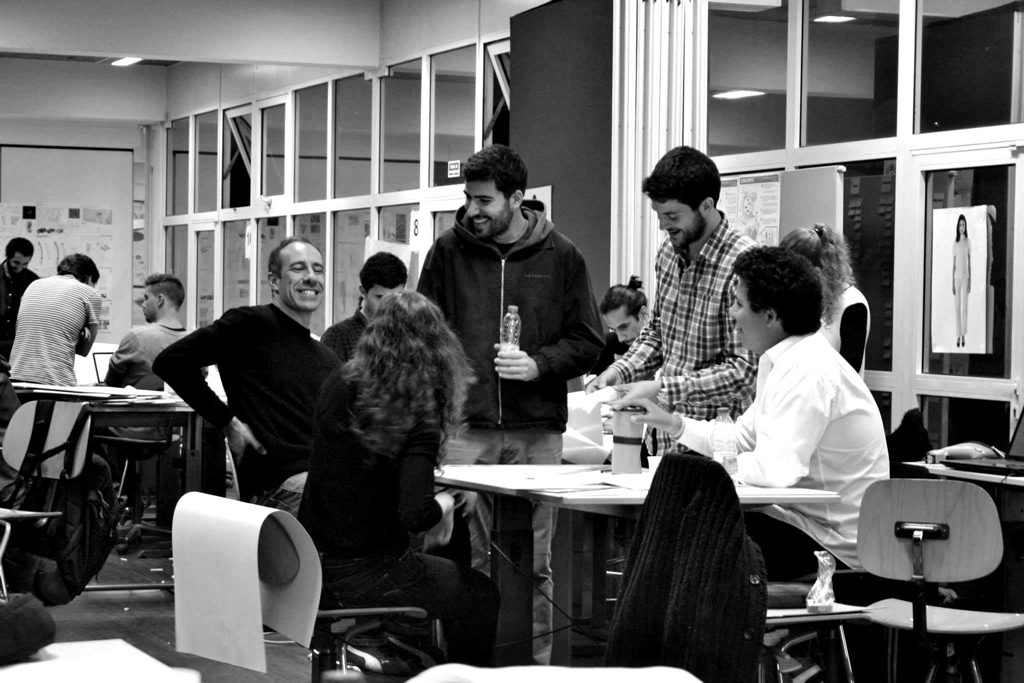
‘Angular’ starts as a group of seven architecture students who get together to create a young collective, aiming for practical skills and teamwork experience, through partaking in competitions and developing cultural and architectural projects. Before we met, we already discussed some theoretical architectural themes, consequently also focused on society and how it perceives architecture. At ENEA (National Architecture Students Meeting), in Porto, we met and realised that beside these preoccupations we shared some thoughts about the insufficient dynamics in our Universities actions.
We got together because we believe that group reflection and debate can lead to more productive and complete conclusions. It allows us to have a more accurate and wider range of action.
We started seeing architecture as a very interesting tool to change society. Of course it is closest to our capacities and areas of interest, but it has this very peculiar characteristic of being broad and extended to almost all fields of knowledge. Architecture somehow has the capability of bonding scientific, social and artistic areas in its own character, revealing itself as a product of this eclectic combination. However, this potentially wide scope of Architecture gets reduced by the unadapted common path we have come to expect from our architecture students and by the actual professional activity in our country, both insufficiently open to these other areas of knowledge. So, if we first started as a group of students that enjoyed working together and debating architecture with each other, we soon concluded we should define our stance facing the major problems we detected, starting with the nearest ones.
Zoom-In
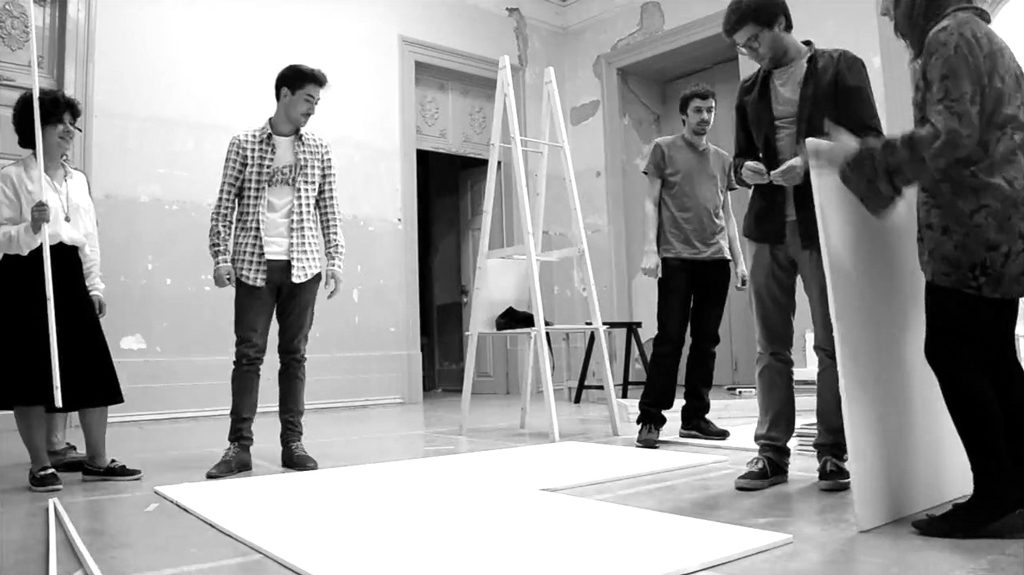
Contextualized by the Bologna Process, our architecture course at Faculdade de Arquitectura da Universidade de Lisboa suffered a great compression of working hours, project classes and a constriction of programmatic contents. These factors, allied with the lack of proactivity and motivation by professors, due to salary cut-offs, and students, conducted to an almost total abandon of complementary activities and actions.
We deem this “extra-curricular” activities absolutely necessary to the health of our school. Students’ works exhibition, interdisciplinary contests, visits to architecture offices and buildings, traveling and getting to know other realities, are absolutely necessary because we see formation as more than what you absorb from classes, it is about what surrounds you and the creative environment that can push you further.Plus, we noticed an inexistent connection between all six Lisbon’s schools of architecture, a great handicap in what could, or should, be a Lisbon School of architecture. Maybe this way, with a consortium of the Lisbon’s schools, we would get more diverse architectural thoughts and conceptions and we would be able to treat this new potential diversity as an advantage, pushing for a positive communication between these conceptions. Thus, facing these problems as potential leaps forward, adding the overspecialization concern and the holistic mindset, we made an effort to generate structures that would allow us to approach the task of closing these gaps in our learning system in a pro-active way.
Past-Present / Reactions
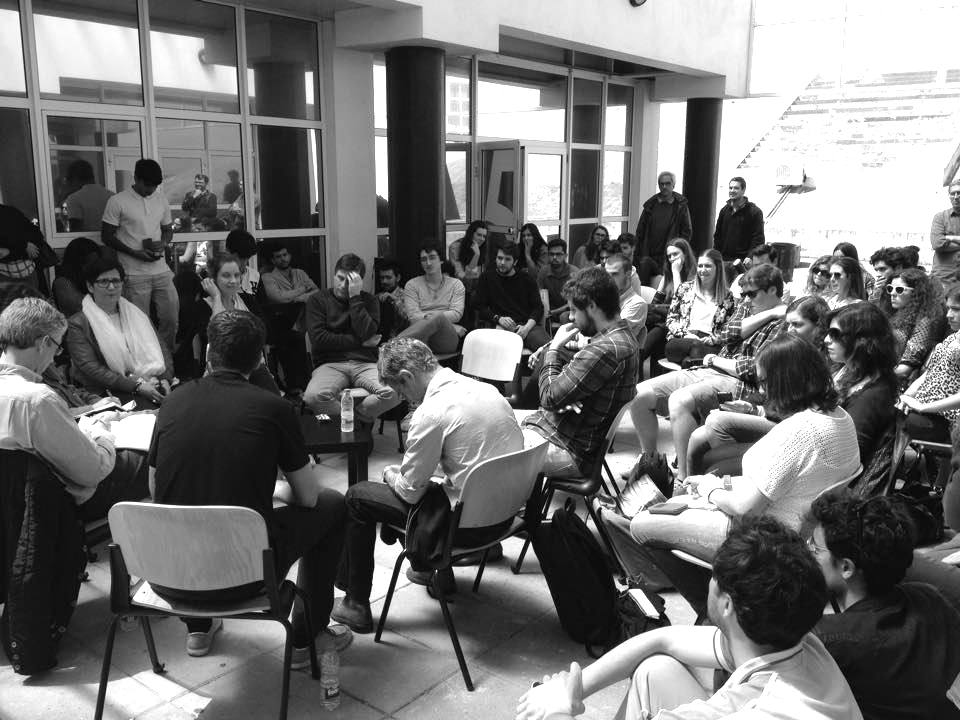
We enrolled in NAVE – student’s cultural core of the school of architecture – that is, at this moment, institutionalized. It incorporates about thirty students and produces a regular program for the academic community. With this initiative, we intend to promote events such as conferences, debates, competitions, exhibitions, and to quake our school panorama. Leading students to events outside the classroom, creating a critical mindset not only between students but also among professors, promoting a contact between them, developing opportunities for students to show their work, to see each others work, to work together and to get to know other disciplines: we believe this to be a good way of starting to practice a new education dynamic. The “mesa redonda com belas artes (round table with fine arts)” project has proportioned the inter-action between architecture and beaux-arts students, trying to recover their long time relationship. This interdisciplinary development produced an exhibition, hosted at Lisbon Architecture Triennale’s headquarters, showing very good results about this thought sharing experience.
Intentions / Future
Keeping the same course, we intend to, throughout the next year,l work on PONTE (bridge) project. This venture aims at stimulating strong bonds and a wide thought sharing mass among all six architecture schools in Lisbon and also between other schools of artistic, technical and social areas, thus generating a broad intellectual platform of critical valid reactions to our panorama.